Marine Paint Application Techniques: How to Brush, Roll and Spray Marine Coatings
Marine Paint Application Techniques: How to Brush, Roll and Spray Marine Coatings
Applying marine paint correctly is just as important as selecting the right coating. A suitable marine coating can still perform poorly if the surface is inadequately prepared, the wrong application method is used, the coating thickness is inconsistent or the environmental conditions are unsuitable.
Marine paint application techniques commonly include brushing, rolling and spraying. Each method has different advantages and limitations, and the appropriate choice depends on the coating product, vessel area, surface condition, accessibility and requirements specified by the manufacturer.
This guide explains the main methods used to apply marine coatings and the important steps that should be considered before, during and after application.
Why Marine Paint Application Matters
Marine coatings are exposed to demanding conditions, including moisture, salt spray, sunlight, abrasion, chemicals and changing temperatures. The coating system needs to form a continuous and properly bonded film to provide the intended protection.
Application quality affects the final coating. Runs, sags, dry spray, missed areas, excessive film thickness, insufficient film thickness and poor intercoat adhesion can all affect coating performance.
AMPP’s marine coating training programs cover surface preparation, coating application, brush and roller techniques, spray application, film-thickness measurement and inspection, reflecting the importance of application control in marine coating work. See AMPP’s marine surface preparation and paint application guidance. :contentReference[oaicite:1]{index=1}
Start With Proper Surface Preparation
Before deciding whether to brush, roll or spray, the substrate needs to be properly prepared.
Surface preparation can involve removing dirt, grease, oil, salts, rust, loose paint and other contaminants. Depending on the substrate and coating specification, preparation may involve hand or power tools, abrasive blasting, waterjetting or other approved methods.
The required preparation level depends on the coating system and substrate. A steel surface receiving a new anticorrosive coating may require a different preparation procedure from a previously painted fiberglass or aluminum surface.
Our guide on how to prepare and apply marine paint covers surface preparation and coating application in greater detail.
Check the Surface Before Painting
Before applying the coating, inspect the surface for remaining contamination, loose coating, rust, moisture and other conditions that could affect adhesion.
Do not rely only on visual appearance. The coating manufacturer’s technical specification should determine the required preparation standard and application conditions.
Marine Paint Application by Brush
Brush application is one of the simplest marine paint application techniques and is particularly useful for smaller areas, edges, corners, touch-ups and locations where spray equipment cannot be used effectively.
Brushes can also be useful for working around fittings, welds, difficult corners and other details where achieving complete coverage with a roller or spray gun may be difficult.
Advantages of Brush Application
- Useful for small and detailed areas.
- Requires relatively simple equipment.
- Suitable for touch-up and repair work where specified.
- Can help coat edges and difficult-to-reach areas.
- Useful where overspray needs to be minimized.
Limitations of Brush Application
Brush application can be slower on large surfaces and may leave visible brush marks if the product and application technique are not suitable. It can also be more difficult to achieve consistent film thickness across a large area.
For this reason, the product’s technical data sheet should be checked to determine whether brush application is an approved method and what application conditions are required.
AMPP’s C6 coating-application training specifically covers brush and roller application, including wet-film thickness measurement and curing considerations. :contentReference[oaicite:2]{index=2}
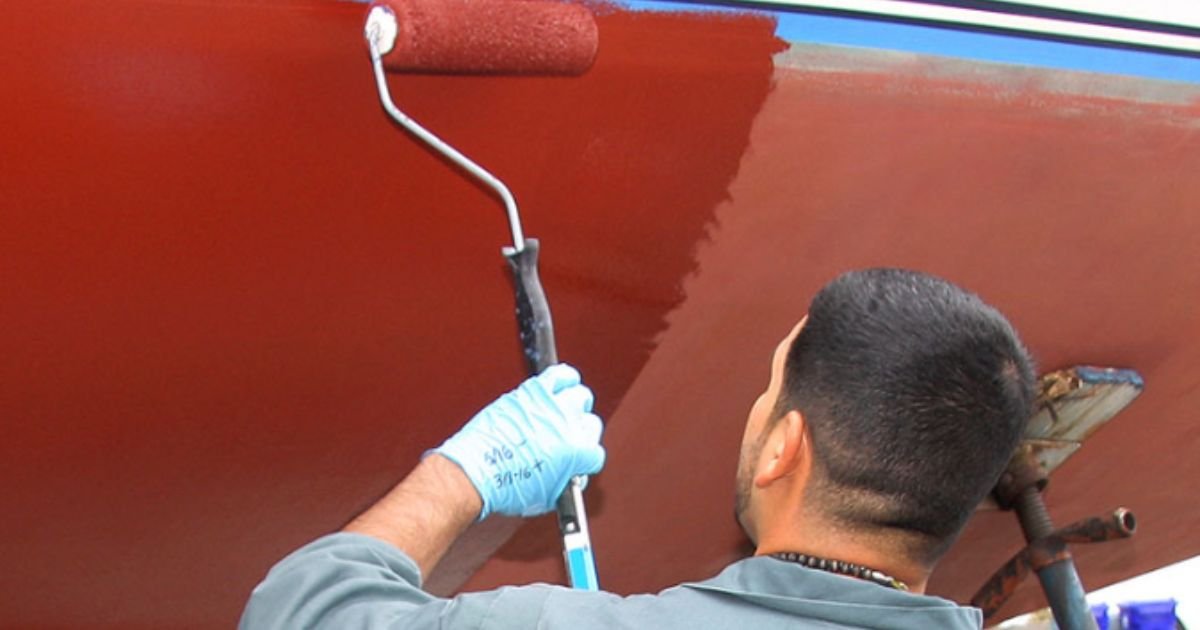
Marine Paint Application by Roller
Roller application can be useful for relatively broad, accessible surfaces where spray equipment is unnecessary or impractical.
Rollers can help cover larger areas more quickly than a brush, while still avoiding the overspray associated with spray application.
Advantages of Roller Application
- Suitable for broad accessible surfaces.
- Can cover larger areas faster than brush application.
- Useful where overspray control is important.
- Requires less specialized equipment than spray application.
- Can be practical for maintenance and repair projects.
Limitations of Roller Application
The finish and film thickness achieved with a roller depend on the coating product, roller type, application technique and surface profile.
Some high-build coatings can also require careful attention to film thickness when roller-applied. The applicator should follow the manufacturer’s instructions rather than trying to achieve a particular thickness simply by adding more material.
Roller application can also be less suitable for complex geometries, narrow areas and surfaces where a particular finish quality is required.
Marine Paint Application by Spray
Spray application is commonly used when large areas need to be coated efficiently and a consistent finish is required.
Depending on the coating and specification, marine coatings may be applied using airless spray, conventional spray or other specialized spray equipment.
AMPP’s current coating application training covers spray application alongside surface preparation, equipment handling and application techniques. :contentReference[oaicite:3]{index=3}
Advantages of Spray Application
- Efficient for large surface areas.
- Can provide a uniform finish when properly controlled.
- Useful for complex vessel surfaces and structures.
- Can provide productive application of suitable high-build coatings.
- Can reduce application time on large projects when conditions and equipment are appropriate.
Limitations of Spray Application
Spray application requires more equipment, preparation and operator skill than basic brush or roller work.
Overspray can also be a significant consideration, particularly around equipment, nearby vessels, buildings and other areas that need protection.
Wind and other environmental conditions can affect spray application, and appropriate ventilation and personal protective equipment are essential according to the coating’s safety requirements.
Airless Spray vs Conventional Spray
Airless spray and conventional spray are not the same application process.
Airless spray uses high fluid pressure to atomize the coating, while conventional spray uses compressed air as part of the atomization process.
The appropriate system depends on the coating, equipment, desired finish and manufacturer’s recommendations.
AMPP’s coating training resources include airless and conventional spray application among the methods used in industrial coating work. :contentReference[oaicite:4]{index=4}
The applicator should use the equipment setup, tip/nozzle selection, pressure and thinning instructions specified for the particular coating rather than applying generic settings to every product.
How to Choose Between Brush, Roller and Spray
The best application method depends on the project rather than on one method being universally suitable.
Choose Brush Application When
- The area is small or highly detailed.
- Edges, corners or fittings require careful application.
- Touch-up work is being performed.
- Overspray must be minimized.
- The coating manufacturer permits brush application.
Choose Roller Application When
- The surface is relatively broad and accessible.
- A practical maintenance application is required.
- Overspray needs to be controlled.
- The coating is approved for roller application.
- The required finish can be achieved using a roller.
Choose Spray Application When
- Large areas need to be coated.
- The product is designed for spray application.
- Appropriate spray equipment is available.
- The work area allows proper overspray control.
- The applicator has the necessary experience and equipment.
Marine Paint Film Thickness Matters
Applying too little or too much coating can affect performance. This is why film thickness is an important part of marine coating application.
Wet-film thickness can be checked during application using an appropriate wet-film thickness gauge. Dry-film thickness can be measured after the coating has cured using the appropriate inspection equipment.
AMPP’s marine coating application training specifically includes wet-film thickness measurement after brush and roller application and also covers inspection and curing. :contentReference[oaicite:5]{index=5}
The target film thickness should come from the product technical data sheet or approved coating specification. It should not be guessed based on appearance alone.
Mixing Two-Component Marine Paint
Many marine coatings are supplied as two-component systems consisting of a base and curing agent.
These products require the components to be mixed according to the manufacturer’s specified ratio and procedure. Incorrect mixing can affect curing, adhesion and final coating performance.
Before mixing, check the product technical data sheet for:
- Mixing ratio.
- Induction time where applicable.
- Pot life.
- Recommended thinner, if permitted.
- Application temperature.
- Recoat interval.
- Curing requirements.
For example, Morven’s Jotamastic 90 is listed as a two-component epoxy mastic coating. Products of this type should be mixed and applied according to the manufacturer’s current technical documentation rather than using generic mixing instructions.
Environmental Conditions During Marine Paint Application
Temperature, humidity, surface temperature, dew point, wind and ventilation can all affect coating application and curing.
A surface may appear dry while still being unsuitable for coating if condensation or moisture is present. Similarly, excessive heat can affect the way a coating flows, levels or cures.
Spray application also requires careful consideration of wind and overspray.
AMPP’s current coating application training identifies environmental conditions, process control, surface preparation, application and inspection as important parts of coating work. :contentReference[oaicite:6]{index=6}
Allow the Marine Coating to Cure Properly
Drying and curing are not necessarily the same thing.
A coating may become dry to touch before it has developed the properties required for service. Recoating too early or exposing the coating to water, chemicals or mechanical stress before the manufacturer’s specified cure can affect the final result.
Always follow the product-specific drying, recoat and curing times.
This is particularly important with two-component epoxy and polyurethane systems where chemical curing contributes significantly to the final coating properties.
Common Marine Paint Application Problems
Runs and Sags
Runs and sags can occur when excessive wet coating is applied or the application technique is unsuitable for the surface and product.
Dry Spray
Dry spray can occur during spray application when coating particles partially dry before reaching the surface. Equipment setup, application distance, environmental conditions and coating viscosity can influence the result.
Uneven Film Thickness
Inconsistent application can leave some areas with insufficient coating while others receive excessive material. Proper application technique and film-thickness checks can help identify this problem.
Poor Adhesion
Poor adhesion may be related to surface contamination, inadequate preparation, incompatible coatings, unsuitable environmental conditions or incorrect application.
Adding another coat without identifying the underlying cause does not necessarily correct the problem.
Marine Paint Application on Different Vessel Areas
Different areas of a vessel can experience different service conditions.
For example, topsides and superstructures are generally exposed to atmospheric conditions, while underwater hull areas may require immersion and antifouling systems.
External decks can experience foot traffic and mechanical wear, while tanks and other enclosed areas may have separate coating requirements.
Our guide on marine topside paint explains the coating considerations for above-water vessel areas.
For a broader overview of vessel coating selection, see how to choose the right marine paint.
Marine Paint Application in Nigeria
Marine coating projects in Nigeria may involve conditions such as high humidity, intense sunlight, rainfall, salt spray and coastal exposure. These conditions make surface preparation, application conditions and coating maintenance important considerations.
The correct coating system should be selected according to the vessel area, substrate, environmental exposure and manufacturer’s technical specification.
Morven Industrial’s marine paint collection includes products for different marine coating applications, including epoxy coatings, primers and finish coats.
Where a project involves a particular vessel, substrate or existing coating, product selection should be based on the relevant technical data rather than assuming that one marine coating is suitable for every surface.
Marine Paint Application Checklist
Before starting a marine coating project, confirm the following:
- The substrate has been correctly identified.
- The existing coating condition has been assessed.
- Surface contaminants have been removed.
- The required surface preparation has been completed.
- The coating system is compatible with the substrate.
- The correct primer and finish coat have been selected.
- The application method is approved for the product.
- Environmental conditions are suitable.
- Two-component products have been mixed according to the manufacturer’s instructions.
- Wet-film or dry-film thickness is being checked where required.
- Recoat and curing intervals are being followed.
- Final inspection is completed before the vessel returns to service.
Final Thoughts
Marine paint application techniques are not simply about deciding whether to use a brush, roller or spray gun. The quality of the finished coating depends on the entire process, beginning with surface preparation and continuing through mixing, application, film-thickness control, curing and inspection.
Brush application can be useful for small areas and detailed work. Rollers can be practical for broad accessible surfaces, while spray application can be efficient for large areas when the equipment, environmental conditions and product specification allow it.
The correct method should always be selected according to the coating manufacturer’s technical data and the requirements of the vessel area being coated.
If you need marine paint or protective coating products for a vessel or industrial application, contact Morven Industrial with details of the substrate, vessel area, existing coating and intended application so the appropriate coating requirements can be reviewed.
Posts Widget
-
1

-
2

-
3

-
4